
Different Types of Tennis Grips: A Complete Guide for Every Player
What Is a Tennis Grip and Why Does It Matter?
So you’ve got the shoes, the racket, and the competitive fire—but your shots still feel off? The issue might not be your footwork or swing. It could be your grip.
In tennis, the grip is more than just how you hold your racket. It’s how you connect with the ball. The way your hand fits around the racket directly influences your topspin, control, power, and even how comfortable you feel during long rallies. Tennis Grip helps define your playing style.
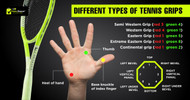
Take a closer look at the handle of your racket. It’s not round—it’s made up of eight flat bevels. Depending on which bevel your index knuckle and heel pad land on, you’ll fall into one of the various grip styles. That’s how we get the different types of tennis grips that cater to different strokes.
From slicing backhands to smashing winners down the line, understanding different tennis grips mechanics gives you an edge. It’s not just about what feels right. It’s about matching your grip to the way you want to play. That small adjustment could make a world of difference.
Understanding Tennis Grips
The bevels are counted from 1 to 8 in a clockwise pattern for a right-handed player and counterclockwise for a left-handed player. Hold the racket perpendicular to the ground, then the bevel 1 will be facing up. These bevel numbers are very important to remember as this gives you an idea of the different grips in tennis while getting used to it.
CTA: Get The Best Tennis Grips Now
6 Most Common Types of Tennis Grips
Let’s get into the different types of tennis grips. Think of these as tools in your kit. Each one has its own purpose. Some are forgiving. Some are demanding. Some are built for finesse, others for firepower.
- Continental Grip
It’s often the first grip players learn, and for good reason. Imagine shaking someone’s hand—yep, that’s the motion. Your hand rests on bevel 2. It’s perfect for slices, volleys, and serves. But for big, topspin forehands? Not so much. - Eastern Forehand Grip
Now we’re talking classic. Continental grip lives on bevel 3. It’s versatile and can handle flat shots, a bit of topspin, and even net approaches. It’s often a beginner’s first “real” grip. - Semi Western Grip
The modern superstar. Found on bevel 4, continental grip is what most of today’s pros use. It helps you crank out powerful, topspin-heavy forehands from the baseline. - Western Grip
This one? A bit of a wild card. Resting on bevel 5, it generates massive topspin. Fantastic for high-bouncing clay courts, but less forgiving on faster, low-bounce surfaces. - Eastern Backhand Grip
One-handers, this is your playground. Placed on bevel 1, it’s ideal for players who like crisp, elegant backhands with some slice or spin. - Double Handed Backhand Grip
Continental grip is a two-part story. Dominant hand on bevel 2, non-dominant on bevel 6 or 7. It’s a stable, powerful choice for returning fastballs or slugging it out on the baseline.
You’ll start noticing something as you experiment: your grip doesn’t just affect how the tennis ball flies. It affects how you move. Your timing. Your footwork. Your confidence. It’s all connected. At TennisShop.ae, we have the largest collections of different types of tennis grips in the UAE.
Continental Grip
The Continental tennis grip often called the chopper or hammer grip is your go-to for serves, defensive shots, volleys, slices, and overheads. To know you’ve got it right, check if your thumb and forefinger form a clean ‘V’ shape along the top edge of the racket handle.
Position of the Grip
With continental grip, align your index knuckle and heel pad on bevel 2. Your hand will naturally fall into a hammer-like position—perfect for fast reaction shots.
Advantages
- Excellent for quick transitions at the net
- Useful for serves, overheads, and slices
- Natural feel for backhand volleys and under-spin shots
Disadvantages
- Not ideal for topspin-heavy strokes
- Tough to use effectively for modern forehand rallies
Players Who Used Continental Grip
- Rod Laver
- Margaret Court
- Billie Jean King
- John McEnroe
Eastern Forehand Grip
One of the tennis forehand grip types is the Eastern Forehand Grip. Start by holding the throat of your racket with your non-dominant hand, keeping it waist-high and perpendicular to the ground. At this angle, bevel number 1 should be facing directly up toward you. Now, for the Eastern forehand grip, rotate your dominant hand clockwise to bevel 3 and place your heel pad and index knuckle there. If you’re a lefty, move your hand counterclockwise to bevel 7 instead.
Position of the Grip
Place your index knuckle and heel pad on bevel 3. Right-handers move clockwise to this position from the top; left-handers go counterclockwise.
Advantages
- Simple to use and easy to teach
- Quick to transition to other grips
- Great for players who love hitting flat and approaching the net
Disadvantages
- Offers less topspin than modern grips
- Struggles with shoulder-height balls or clay court bounce
Players Who Used Eastern Forehand Grip
- Chris Evert
- Pete Sampras
- Steffi Graf
- Roger Federer
Eastern Backhand Grip
Another tennis racket grip type is the Eastern Backhand Grip. If you rely on a one-handed backhand for control and spin, the Eastern backhand grip is your best friend. It transitions smoothly,especially if you're already playing with a Western forehand grip. This grip offers a solid mix of control, power, and feel over the ball. It also makes switching grips easier during fast-paced rallies. Bonus? It's a great choice for adding bite to your kick serve too.
Position of the Grip
Grip bevel 1 with your heel pad and index knuckle. This provides a balanced racket face that’s ideal for one-handed strokes.
Advantages
- Allows clean topspin and flat shots
- Smooth grip changes
- Pairs well with Continental Tennis grip at the net
Disadvantages
- High backhand returns are tough to handle
- Not suited for two-handed backhand players
Players Who Used Eastern Backhand Grip
- Pancho Gonzales
- Pete Sampras
Semi-Western Grip
If you’re the kind of player who loves grinding it out from the baseline, the Semi-Western grip might just be your perfect match. When done right, this grip lets you unleash powerful, topspin-loaded forehands that push your opponent deep behind the baseline. Among all forehand grips, the Semi-Western reigns supreme, especially for waist to shoulder-high balls where it offers ideal control and punch.
Position of the Grip
With semi-western grip, your index knuckle and heel pad align on bevel 4. It positions the racket face for maximum topspin with just enough racket speed.
Advantages
- Ideal blend of spin and control
- Works well on both hard and clay courts
- Allows aggressive baseline play
Disadvantages
- Hitting low balls can be awkward
- Fast grip switching at the net may slow you down
Players Who Used Semi-Western Grip
- Novak Djokovic
- Rafael Nadal
- Serena Williams
- Andy Murray
Western Grip
The Western tennis grip can be one of the trickiest grips to master, mainly because consistency is tough to maintain especially on faster courts. That said, it’s unmatched when it comes to generating massive topspin, making it a favorite for players who thrive on heavy, high-bouncing forehands.
Position of the Grip
In western grip, your hand shifts further to bevel 5. This closes the racket face, ideal for brushing the ball and loading it with topspin.
Advantages
- Creates unmatched topspin
- Excellent for high-bouncing balls
- Best grip for slow surfaces like clay
Disadvantages
- Weak against low balls
- Difficult to adapt quickly for volleys or slice
Players Who Used Western Grip
- Karen Khachanov
- Kyle Edmund
- Jack Sock
Double-Handed Backhand Grip
If you're looking for both stability and control on your backhand, the double-handed grip is a solid choice. It’s especially beginner-friendly. Just remember, proper shoulder rotation and a smooth swing are key to generating real power behind the shot.
Position of the Grip
Your dominant hand (usually right) uses the Continental grip on bevel 2, while your non-dominant hand grips bevel 6 (or 7). It’s all about balance and leverage.
Advantages
- Easy to control high-speed shots
- Stable under pressure
- Adds topspin with less effort
Disadvantages
- Reduced reach on wide balls
- Slower to set up than a one-hander
Players Who Used Double-Handed Backhand Grip
- Bjorn Borg
- Jimmy Connors
- Novak Djokovic
How to Choose the Right Tennis Grip
Picking the right grip isn’t about copying your favorite player.It’s about finding what suits your body, style, and goals. Here’s how to decide:
- Assess Your Game
- If you're aggressive and love spinning forehands, go Semi-Western.
- If you charge the net often, Eastern or Continental may suit you better.
- Try Bevel Variations
- Be open to adjusting between grips. You’ll discover nuances that improve your shots.
- Prioritize Comfort
- Don’t force a grip. If your wrist feels strained, it’s probably not the one.
- Stay Flexible
- Top players switch grips mid-match. You should too. Learn to shift between them fluidly.
Evolution of Tennis Grips
The game of tennis didn’t always look the way it does now. Back in the day when rackets were made of wood there was really only one grip: the Continental. Players used it for everything. Forehands, backhands, volleys, serves. One grip ruled them all.
But then the game got faster. Rackets evolved. Strings changed. Courts got quicker, and players started chasing new ways to control the ball. That’s when the grip revolution began.
Forehand Grips
Bill Johnston, way back in the early 1900s, used a Western grip before most people even knew what that was. As time moved on, players like Björn Borg introduced heavy topspin, and suddenly the Eastern grip became mainstream. Fast forward a few decades, and the Semi-Western took over thus blending power and spin in a way that matched the modern game perfectly.
Backhand Grips
The evolution here was even more dramatic. For years, the one-handed backhand, usually with an Eastern grip, was the standard. But as players started hitting harder and rallies grew longer, the double-hander became more practical. More stable. It offered the kind of consistency that the fast-paced game demanded.
Today? Most pros know more than one grip. They adapt. They switch mid-point. Because in modern tennis, flexibility is power. And it all starts with how you hold the racket.
Tips to Switch or Improve Your Tennis Grip
Grip changes feel clunky at first. That’s okay. Practice them during drills, not just during matches. Use your non-dominant hand to rotate the racket while loosening your dominant hand.
Try transitioning from Eastern Grip to Semi-Western forehand mid-practice. It teaches your wrist how to handle different racket angles. Do this slowly, repeatedly, until it becomes second nature.
NOT ALL GRIP IS GOOD FOR EVERY SHOT
Each grip has its moment. No one grip rules them all. If you want to play smarter, experiment during training—not tournaments. Practice your smashes with one grip, your backhands with another. You’ll be amazed at how adaptable your game becomes.
FAQs
1. What is the best tennis grip for beginners?
The Eastern forehand grip is ideal. It’s forgiving, intuitive, and great for learning form and control without overthinking.
2. What grip do most pros use?
The Semi-Western grip dominates for forehands. For backhands, most pros use a two-handed grip with Continental and Semi-Western variations.
3. What is the most popular grip in tennis?
Right now, it’s the Semi-Western. It offers balance, depth, and the topspin needed for modern play.
4. What is the difference between Eastern and Western grips?
Eastern (bevel 3) is more neutral—flat and versatile. Western (bevel 5) is extreme, built for spin. The difference is mostly in the angle of contact.
5. What grip is best for topspin?
The Western grip leads for pure topspin, but the Semi-Western is more flexible, delivering spin across all surfaces.