Tennis Rules Explained: Complete Guide for Beginners & Players
If the scoring and rules in tennis have ever made you stop and think, “Why is this so confusing?” — you’re not alone. Tennis is one of those sports that seem simple when watching, but the first time you hear terms like love, deuce, add-in, fault, let, and all the court lines, it can feel a bit overwhelming.
The good news? It’s actually much easier to understand once someone explains it.
This guide will break down the basic rules of tennis, how a court is set up, what happens during a point, singles vs. doubles and a step-by-step rundown of how tennis scoring works.
Whether you’re a complete novice, picking up your first racket to play or just want some guidance in watching matches and understanding what’s happening on the court, this guide will give you more confidence about the game from beginning to end.
Why Understanding Tennis Rules Is Important
A lot of beginners enjoy watching tennis with excitement, but as the game advances, they feel lost. The game has its own language and patterns, so without knowing the rules, even simple moments in a match can feel confusing. Afterall who wants to be an unlearned beginner in this glamorous game?
That is why learning the rules early makes such a big difference. When you understand the various factors which impact the game, like court lines, serve sequence, point flow, and scoring system, you stop guessing and start reading the game properly.
Practice is also more useful, as you aren’t only competing – you’re discovering how to score within the game’s regulations. And it stops you dropping points you shouldn’t. A player might get a powerful serve off, but still concede the point if the serve doesn’t reach the proper service square. In the same way, if you aren’t absolutely certain of the difference between the singles and doubles sidelines, it’s simple to wrongly call a good shot during a rally.
In short, rule awareness improves confidence, decision-making, and enjoyment. Once the basics are clear, tennis feels less frustrating, more structured, and much easier to follow whether you are playing for the first time or watching matches more seriously.
Basic Tennis Rules Every Player Should Know
Tennis is a strategic sport that is enjoyed across the world. Getting started with the game is easier than you think. You should know about basic tennis rules to understand the objective of the game. The primary objective is to hit the ball and get it over the net. As the ball reaches the court boundaries of the opponent, you can win points by delivering shots that they are not able to return.
According to the rules of tennis, you can play the game in singles or doubles by following a set of structured rules and a unique tennis scoring system. As you set on the court, you will require essential components, including:
Tennies Rackets that suit your grip preference and skill level
Tennis balls that deliver a consistent bounce
A net that divides the court equally. The net should be at least 3 feet in the center.
A standard court, which is 23.77m in length. For singles, the width is 8.23m. For doubles courts, the width is 10.97m.
It is also important to choose the right Tennis shoes, especially when you are playing on hard courts. You could be aiming to play competitively or casually. Understanding tennis basics will help build a strong foundation. Once you are equipped with the right court essentials, you should know about the tennis court rules, tennis points, and tennis gameplay.
Tennis Scoring System Explained
Proper tennis scoring might appear complicated. However, it follows a well-structured system. Every game starts with the ‘love’ scoring system. It refers to the zero count. Then, the game progresses through 15, 30, 40, and finally to the ‘game’ when the player wins four points. However, if both players reach 40-40. It is referred to as the ‘deuce.’
When the player reaches deuce, they are expected to win two points in a row, including the advantage and the game. In typical tennis scoring rules, matches are won by winning the best-of-five or best-of-three sets. Each set requires at least six games, along with a two-game lead. Tiebreakers can decide sets tied at 6-6.
Tennis Serving Rules Explained
To understand the tennis serving rules, you should know about the right serving technique. A perfect serve commences behind the baseline. Serving in tennis should be done diagonally into the service box of the opponent. The server receives two attempts. In case both are missed, it is referred to as a ‘double fault.’ In this case, the point is lost.
On the other hand, a clean & unreturned serve is referred to as an ace. Be attentive to foot faults or stepping on or over the baseline while serving. This will invalidate your serve. Serves that fall outside the box and hit the net without falling into the box will be counted as faults.
Tennis Court Rules and Dimensions
Once the tennis ball is in action, it is expected to land within the court boundaries. In this case, the lines count as in. When the ball lands outside the court or bounces twice before the return, you will lose a point. Volleying (hitting before the bounce) is permissible anywhere except inside the court of the opponent.
Some of the common faults include double hits (when you strike the ball twice) and net interference (touching the net during the game). These interactions can make you lose points.
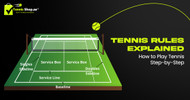
For dimensions, a standard tennis court is 78 feet (23.77m) long. The court is twenty-seven feet wide for a game for singles (that’s 8.23 metres) and thirty-six feet wide for doubles on each side; (10.97 metres). The net is three feet high in the middle, and roughly three and a half feet at the net posts. Having these sizes allows tennis rules to remain the same, whether you’re playing a casual game or a contest.
Common Tennis Rule Violations
Also, apart from the usual in-play mistakes, tennis has a system of rules governing conduct for breaches. Things people are often penalised for in tennis include swearing out loud, being verbally rude to others, damaging their racket or a ball, acting in a way that isn’t sporting, and coaching or delay-related penalties, depending on the event level and rulebook used. If you do this more than once, the penalties can get worse, starting with a warning, then a point taken away, then a game, and, in particularly bad cases, you can be disqualified.
For beginners, the key takeaway is simple: learn the tennis rules and tennis sport rules for both play and behavior. Calling the score correctly, respecting line calls, and controlling reactions are all part of tennis gameplay,not just hitting the ball cleanly. This makes matches fairer and more enjoyable for everyone on court.
Tennis Rules for Singles vs Doubles Matches
Court Boundaries: Singles makes use of a 27-foot length and 8.23m width court. While in doubles tennis rules, the court expands to 10.97m in width.
Serving Order: In a singles game, one player will serve for every game. In case of a doubles game, four players will take turns to serve the ball.
Player Positions: The serving partner is allowed to stand anywhere. On the other hand, returners remain on the designated deuce for the whole game.
Time to Hit the Court – Get Your Tennis Essentials from TennisShop.ae
Having learned the rules of tennis in a way that’s easy for new players, the thing to do next is to prepare for games by getting the correct tennies equipments from a good place. TennisShop.ae’s tennis section has all the important things a player requires – tennies apparels,rackets, balls, shoes, bags, nets, extras, and services like restringing and replacing grips. Because of this, it’s a handy single location for people who are learning tennis from the start, and those who are improving what they already have.
If you’re often going over tennis points, serving in tennis, and the rules of the court, then having dependable basics – particularly shoes, balls and a racket to suit your ability is vital. The site’s blog also has tennis material designed for beginners; (the rules, sizes, and serving are all covered) and it’s good to have alongside learning the tennis rules and gradually becoming a better player.
FAQs
1. What are the basic rules of tennis for beginners?
While serving, players should take turns. Moreover, you should aim to hit the ball within the opponent’s court.
2. How does scoring work in tennis?
Points advance from 15, 30, 40, and game in a match. A player is expected to win the game by 2 points.
3. How long is a set in tennis?
Typically, a set in a tennis game is played until one player wins six games with at least a 2-games lead.
4. What is a tennis tie-break, and when is it used?
A tie-break is played when the set is tied at 6-6. The one who reaches 7 points first with a 2-point lead will win the set.
5. What are the differences between singles and doubles tennis?
Singles courts feature a narrower court. On the other hand, a doubles court uses a full court, including alleys.
6. How many sets do you need to win a tennis match?
In a typical match, the best of three sets will win. In Grand Slams, it is the best of 5 sets.
From Our Blog

7 Steps to Master a Tennis Serve (Beginner’s Guide)

7 Tips to Choose the Best Padel Shoes | Complete Guide

Pickleball Rules Explained: Full Beginner Guide

Dubai Duty Free Tennis Championships 2026: Complete Guide

Pickle Ball vs Padel: What’s the Difference in Rules and Play?

Guide to Mubadala Abu Dhabi Open 2026: Tickets & Info

Tennis Elbow Exercises & Prevention: Complete Player Guide

Six Kings Slam 2025: Sinner’s Win & Riyadh’s Tennis Rise

Top Longest Tennis Matches Ever Played in History

Australian Open 2026: Everything You Need to Know

Top Tennis Warm Up Exercises to Boost Performance

Top 10 Health Benefits of Playing Tennis You Need to Know

Roger Federer Net Worth in 2025: The Billionaire of Tennis

Top 10 Tips for Playing Padel Like a Pro | TennisShop.ae

Laver Cup vs Davis Cup – Everything You Need to Know

ATP Champions: Top 10 ATP Legends Who Ruled the Tour

Rolex Paris Masters 2025: Guide to the Paris Master Open

Best Padel Shoes 2026 in UAE: Top Picks for Every Player

Top 10 Best Padel Clubs in Dubai to Play

Tennis Court Dimensions: Complete Size Guide | TennisShop.ae

Padel vs Tennis: Key Differences Explained | TennisShop.ae

Fastest Tennis Serve Ever & Tips on How to Serve Like a Pro

Best Accessories for Tennis Every Player Needs

The Rise of Famous Tennis Stars: Who to Watch in 2026

Evolution of Tennis: From History to Modern Game

ITF Junior Tennis Guide: Rankings, Rules & Path to Pro
Tennis Rules Explained | Scoring, Serving & Match Rules for Beginners

Top 10 Greatest Tennis Player of All Time | Greatest Legends Ranked

Tennis for Health: How Tennis Can Improve Your Fitness & Health

Where to Play: Best Indoor Tennis Courts Dubai

How ATP & WTA Rankings Work | Tennis Rankings Guide

Wimbledon 2025 Guide: History, Format & Key Matches

Coco Gauff’s Net Worth

Jannik Sinner Net Worth 2026: Earnings, Titles & More

Jannik Sinner, the second consecutive winner of the Australian Open 2025 tournament in the Men’s singles category

Novak Djokovic Wins Against Carlos Alcaraz at Australian Open 2025

Daniil Medvedev’s Net Worth: An Overview Of His Financial Success

Best Tennis Racket Brands in Dubai 2026 | Buying Guide

Best Tennis Academies in Dubai | Top 5 Coaching Centers

10 Ways AI is Being Used in Tennis 2025

Top 10 Tennis Rackets Used by Famous Players in 2026

Best Tennis Courts in Dubai 2025: Top Courts and Prices

Will Novak Djokovic also follow Rafael Nadal’s Retirement?

The French Open vs Wimbledon: A Comparison

Rafael Nadal’s Net Worth: Financial Overview of the Tennis Legend