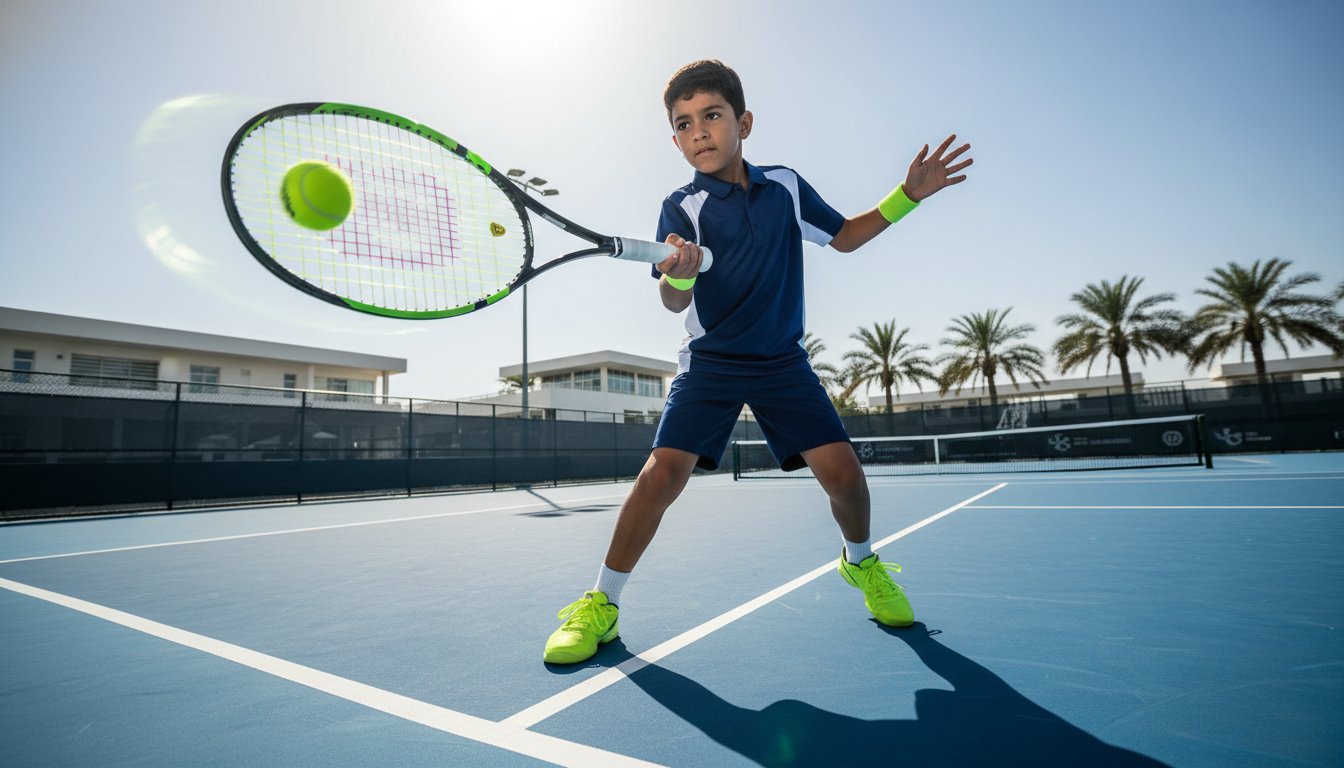
Handing your child a racquet that's even two inches too long isn't just a minor gear mismatch; it's a biomechanical gamble that can stall their progress and risk injury to developing joints. With over 6.5 million junior players now competing globally, the demand for precision equipment has never been higher. Finding the right wilson junior tennis racquet is the most critical decision you'll make for your young athlete in the UAE this season. It's the difference between a fluid, powerful swing and a frustrated struggle on the court.
You want to give your child every advantage, yet the choice between affordable aluminum and high-performance graphite models often feels overwhelming. It's natural to worry about tennis elbow or buying a frame they'll outgrow in months. We're here to turn that confusion into a competitive strategy. You'll learn how to select a frame that accelerates development while keeping those growing joints safe from unnecessary strain.
This guide provides a definitive 2026 sizing chart based on the latest Wilson height recommendations and USTA regulations. We break down the technical differences between the new Blade v10 and Ultra v5 series so you can shop with total confidence. Get ready to master the art of equipment selection and set your junior player on the path to excellence.
Key Takeaways
- Learn why height is the only metric that matters when sizing a wilson junior tennis racquet and how to perform the "floor test" at home to ensure a perfect fit.
- Identify the performance differences between the Blade, Clash, and Ultra series to match your child’s specific playing style and physical needs.
- Recognize the critical transition point where moving from aluminum to graphite composite frames becomes a performance necessity for competitive growth.
- Understand why professional racquet stringing and fresh grips are essential for preventing injury and maintaining control during intense play.
- Navigate the jump to adult frames by identifying "Lite" and "Ultra Lite" specifications that provide power without compromising a young player's mechanics.
The Wilson Junior Sizing Framework: Height vs. Age
Selecting the right frame is a choice that dictates your child's technical ceiling. While many retailers categorize gear by age, this is a flawed approach that ignores the rapid growth spurts common in young athletes. Height is the only reliable metric for choosing a wilson junior tennis racquet. When a racquet is sized correctly to a player's height, it aligns with their natural swing arc and contact point. If the frame is too long, the child is forced to "muscle" the ball using their shoulder rather than developing a fluid, full-body motion. This technical compensation doesn't just slow down their progress; it places undue stress on developing tendons.
Understanding the evolution of racquet materials helps explain why modern Wilson frames provide such high stability at lighter weights. Gone are the days of heavy, unwieldy wooden frames. Today's junior models use advanced composites to ensure that even a 19-inch frame offers a professional feel. However, the benefits of these materials are lost if the geometry is wrong. A racquet that's too long will frequently strike the court surface during low balls, leading to frustration and equipment damage.
Height-Based Selection Chart
Use these height ranges to narrow down your search. These measurements ensure the racquet length complements the child's wingspan and reach.
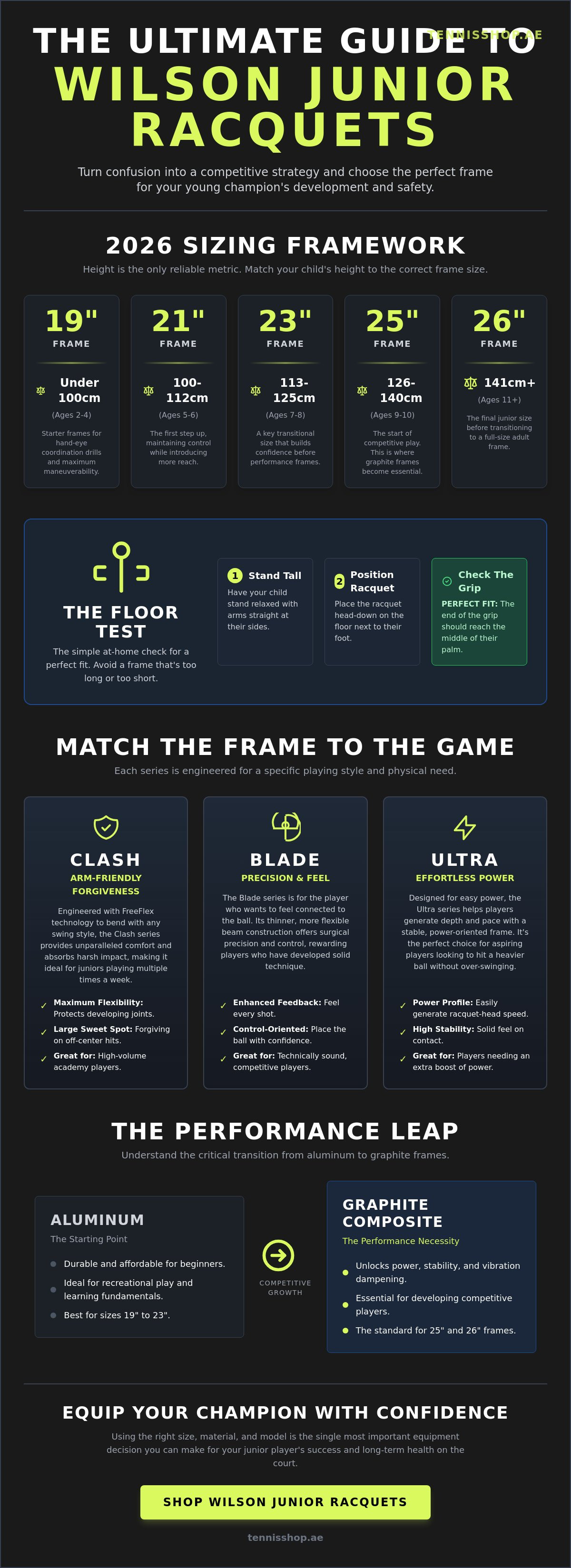
- Under 100cm (Ages 2-4): The 19-inch 'starter' frames. These are designed for maximum maneuverability and hand-eye coordination drills.
- 100cm to 125cm (Ages 5-8): Transitioning through 21 and 23-inch models. As your child grows, these incremental steps maintain the correct balance between power and control.
- 125cm to 150cm+ (Ages 9-11+): The critical 25 and 26-inch performance stage. This is where players often move from recreational aluminum to performance graphite wilson junior tennis racquet models to prepare for competitive play.
The Floor Test Protocol
If you're unsure which size fits, perform the "floor test" at home. Have your child stand tall with their shoulders relaxed and arms straight down at their sides. Place the racquet next to them with the head resting on the floor and the handle pointing up. The end of the grip should reach the middle of their palm. If the handle reaches their wrist or higher, the racquet is too short. If they have to bend their arm or lean to reach the handle, it's too long.
Watch for signs of "wrist lag" during practice. If the racquet head consistently dips or feels heavy during the follow-through, it's a clear signal to prioritize a shorter, lighter frame. A lighter racquet that allows for high swing speed is always better for development than a longer one that the child cannot control.
Decoding the Wilson Junior Lineup: Blade, Clash, and Ultra
Wilson's engineering team treats junior development with the same technical rigor as the pro tour. Choosing a wilson junior tennis racquet means matching a specific technology to your child's physical mechanics. These aren't just smaller versions of adult frames; they are specialized tools designed to solve specific on-court challenges. Whether your athlete needs the flexibility of the Clash or the surgical precision of the Blade, each series offers a distinct performance profile. Understanding these differences is the key to unlocking their potential and preventing the frustration that comes from using ill-suited gear.
The lineup is categorized by how the racquet responds to the ball. Some frames are built to flex and protect, while others are designed to remain stiff and powerful. For young athletes frequently engaged in high-volume hitting sessions at junior academies, selecting a frame that complements a child's natural swing speed is vital. You can explore the latest Wilson performance frames to see how these designs look in the 2026 v10 and v5 iterations.
Clash vs. Blade: Which Tech Suits Your Child?
The Clash series is the gold standard for arm protection. Its FreeFlex technology allows the frame to bend in all-new dimensions, providing a soft feel that absorbs impact. This is vital for juniors playing multiple times a week at academies. It offers a massive "forgiveness factor," meaning even off-center hits won't vibrate painfully through the arm. In contrast, the Blade features a thinner beam that emphasizes "feel" and precision. It doesn't provide as much "free power," which encourages young players to develop their own strength and correct technique. If your child has a high swing speed and likes to dictate points, the Blade is their weapon.
Ultra and Burn: The Power Perspectives
The Ultra and Burn series focus on maximizing energy return for players who want more depth with less effort. The Ultra utilizes a "Power Pillar" in the throat area. This creates a rock-solid feel during impact, making it the most stable wilson junior tennis racquet for juniors who hit a flatter ball. It's particularly beneficial for players with shorter swings. The Burn takes a different approach by focusing on aerodynamics. Its frame design is engineered to cut through the air quickly, helping quick learners generate the racquet head speed necessary for heavy topspin. Matching the racquet's personality to your child's natural style ensures they don't have to fight their equipment to win points.
Aluminum vs. Graphite: When to Invest in Performance
Choosing between aluminum and graphite isn't just a budget decision. It's a choice that directly impacts your child's physical health and technical ceiling. Most entry-level frames are crafted from aluminum. These are lightweight, incredibly durable, and perfect for the "discovery" phase where the racquet might accidentally meet the court surface more often than the ball. However, as your athlete moves toward competitive play, the material must evolve. A high-quality wilson junior tennis racquet made of graphite composite or full graphite is a precision tool designed to dampen the harsh vibrations that lead to early-onset joint fatigue.
The transition to graphite usually happens when a child reaches the 25 or 26-inch frame size. At this stage, the ball speed increases and the physical demands on the arm intensify. Aluminum frames are hollow and stiff; they transmit the shock of every impact directly into the wrist and elbow. Graphite, on the other hand, features a layered carbon fiber construction that absorbs energy. For young players in the UAE training in high-performance academies, this vibration dampening is a biomechanical necessity. It allows them to practice longer and hit harder without the "stinging" sensation common with cheaper metal frames.
Material Comparison Matrix
Understanding the trade-offs between materials helps you justify the investment in performance gear. Here is how the primary materials stack up:
- Aluminum: High durability and low cost. Ideal for casual play and beginners under age 8. It's nearly indestructible but offers zero shock absorption.
- Fused/Composite: A middle-ground solution. These frames mix graphite with aluminum to provide a lighter feel and better stability than pure metal without the full price of a performance frame.
- Full Graphite: The gold standard for competitive juniors. These offer superior feel, power, and arm protection. While they require more careful handling, the performance benefits are unmatched.
Signs Your Child is Ready for Graphite
Don't wait for a coach to tell you it's time to upgrade. Watch for these three indicators that your child has outgrown their aluminum frame. First, look at their swing path. If they're taking full, aggressive cuts at the ball, they need the stability of graphite to keep the racquet face from twisting. Second, listen to their feedback after a long session. If they complain about hand fatigue or "buzzing" in their arm, the aluminum frame is failing to protect their joints. Finally, if they're entering weekend tournaments or intensive camps, a performance wilson junior tennis racquet is essential to keep them competitive against peers using advanced technology.
Maintenance for Young Pros: Stringing and Grips
Owning a high-performance wilson junior tennis racquet is only half the battle; maintaining its playability is what keeps your child’s game on an upward trajectory. Many parents assume that the strings a racquet comes with are sufficient for the life of the frame. This is a mistake. Factory strings are often designed for shelf life rather than performance. They lose tension quickly, becoming "dead" and forcing the young player to swing harder to achieve the same depth. This extra effort is a primary cause of technical breakdown and unnecessary muscle fatigue. Proper maintenance ensures the equipment works with the player, not against them.
The intense UAE heat can accelerate the degradation of both strings and grips. High temperatures in Dubai and Abu Dhabi cause racquet materials to expand and contract, which saps the elasticity from the strings. If your child is playing twice a week, you should consider restringing their racquet at least every three to four months. Fresh strings provide the "snap-back" needed for spin and the shock absorption required to protect developing joints. It's a small investment that pays massive dividends in player confidence and safety.
Junior Stringing Essentials
Choosing the right string is just as important as the frame itself. For most developing athletes, multi-filament strings are the superior choice over polyester. Multi-filaments are composed of thousands of tiny fibers that mimic the soft feel of natural gut. They offer excellent energy return and a larger sweet spot. Polyester strings, while popular on the pro tour, are often too stiff for junior arms and can lead to wrist pain. For 25 and 26-inch performance frames, we recommend a lower tension range, typically between 48 and 52 lbs. This setup provides a "trampoline effect" that helps smaller players generate depth. For an expert setup, you can access Professional Racquet Stringing to ensure the tension is calibrated perfectly for your child's specific frame.
Grip Size and Overgrips
A grip that's too small or too large can ruin a child's technique. Most junior racquets come in standard sizes like 0, 00, or 000. If the grip is too small, your child will develop a "death grip" habit, squeezing the handle too tightly to keep it from twisting. This tension travels up the arm and restricts the fluid motion of the wrist. You can use overgrips to customize the feel and add a small amount of thickness without significantly increasing the racquet's weight. Replace these overgrips frequently. A fresh, tacky grip allows the player to hold the racquet with a relaxed hand, which is essential for hitting "touch" shots and maintaining control during long rallies. If you notice the grip looks smooth or discolored, it’s already long overdue for a change.
Keep your athlete's equipment in peak condition to avoid injury and performance plateaus. You can book your professional racquet stringing today to give your junior player the competitive edge they deserve.
The Final Step: Transitioning to Adult Frames
Transitioning to a full-size frame is a milestone that marks your child's entry into the adult game. However, jumping into a standard 27-inch racquet too early can derail years of technical work. Many parents fall for the "12-year-old" myth, believing that hitting secondary school age automatically requires a full-size frame. In reality, the decision should be based on physical maturation and swing speed rather than a birthday. A premature switch to a heavy frame often leads to late contact points and a drop in racquet head speed; these are difficult habits to break once they take root.
A typical performance wilson junior tennis racquet weighs around 250 grams. Moving directly to a 300-gram adult frame adds 20% more mass, which is a massive shock to a young player's shoulder and wrist. The goal is a safe, incremental weight progression. Wilson addresses this by offering "Lite" (L) and "Ultra Lite" (UL) versions of their most popular adult models. These frames provide the standard 27-inch length but keep the weight between 260 and 280 grams, providing a bridge that protects the athlete's joints while they adjust to the increased leverage of a longer racquet.
Signs of Readiness for a 27-inch Frame
Height remains your most reliable indicator for this final jump. Once your child reaches approximately 150cm, their wingspan is usually sufficient to handle the extra inch of length without the racquet head dragging during the swing. Beyond physical size, look at their contact point. They must be able to generate consistent head speed and meet the ball out in front of their body. If they are already dominating with a 26-inch graphite wilson junior tennis racquet and their coach notes that they are "out-hitting" the frame's stability, they are ready for the next level.
Choosing the First Adult Wilson
The first adult frame shouldn't be the heaviest or stiffest one on the shelf. While the Pro Staff series is iconic, its weight and demanding sweet spot are often too punishing for a young teen. Instead, focus on frames that prioritize maneuverability and arm health. The Wilson Clash 100L is an exceptional transitional choice because it maintains the series' signature flexibility while offering adult-level stability at a manageable weight. This allows the player to continue developing their swing without the risk of injury. Before you make the leap, ensure you have a clear equipment strategy that accounts for their projected growth over the next 18 months. Browse our full range of Wilson Tennis Racquets to find the next step in your athlete's journey.
- Height Check: Ensure they have reached the 150cm milestone.
- Weight Check: Target a 265g to 280g "Lite" frame for the first year.
- Grip Check: Transition to an adult grip size 1 or 2, using overgrips for a custom fit.
- String Check: Stick with arm-friendly multifilaments during the first six months of the transition.
Equip Your Future Champion for Success
Finding the perfect wilson junior tennis racquet is a strategic investment in your child's athletic future. You now have the tools to size by height rather than age, ensuring their technique remains fluid and injury-free. Whether you choose the arm-friendly flexibility of the Clash or the aggressive precision of the Blade v10, matching technology to their specific playing style is what creates a winning advantage. Proper maintenance is just as vital as the frame itself; fresh strings and tacky grips are the final pieces of the performance puzzle.
As an authorized Wilson premium retailer, we provide the technical expertise and high-performance gear needed to excel on court. We offer expert stringing for all junior frames to ensure they are calibrated for immediate play. With nationwide delivery across the UAE, getting professional equipment to your doorstep has never been easier. Take the next step in their development today. Shop the Latest Wilson Junior Racquet Collection and watch their confidence soar. The court is waiting; let's make every swing count.
Frequently Asked Questions
What is the best Wilson junior racquet for a 7-year-old?
A 23-inch wilson junior tennis racquet is generally the best fit for a 7-year-old who stands between 115cm and 125cm tall. If they are just starting, the lightweight US Open or Roger Federer models provide excellent maneuverability. For more advanced juniors playing in UAE academies, the Blade 23 offers a graphite composite construction that provides better stability and feel as they develop full-swing mechanics.
How do I know if my child's tennis racquet is too small?
You'll know a racquet is too small if your child's swing looks cramped or they are consistently making contact late behind their body. A short frame lacks the necessary leverage for a growing player, forcing them to use too much wrist to generate power. If their hand is reaching the very end of the grip and the racquet head looks disproportionately small during a full arc, it's time to move up.
Is there a difference between boys' and girls' Wilson racquets?
There is no technical difference in weight, balance, or material between Wilson’s junior racquets marketed toward different genders. The frames are engineered based on height and skill level rather than gender. While colors and graphics vary across series like the Ultra or the Blade, the internal technology remains identical. Choose the frame that matches your child's physical height and playing style for the best performance outcomes.
Why are some Wilson junior racquets much more expensive than others?
Price differences are primarily driven by the materials used in construction. Beginner frames are made from lightweight aluminum, which is affordable and durable. Performance models, such as the Clash or Blade, use high-modulus graphite. This material is more expensive to manufacture but offers superior vibration dampening and power. Investing in a graphite wilson junior tennis racquet is essential for competitive players to protect their joints from the impact of harder-hitting balls.
Can a junior player use an adult tennis racquet?
Junior players should only transition to a 27-inch adult racquet once they reach approximately 150cm in height. Moving to an adult frame too early can cause technical breakdown and shoulder injuries due to the increased weight and length. If your child is tall enough but needs a lighter feel, look for "Lite" or "Ultra Lite" versions of adult frames. These provide the necessary length without the punishing weight of a standard tour racquet.
What string tension is best for a junior Wilson racquet?
A lower tension range between 48 and 52 lbs is ideal for most junior players using performance frames. This lower tension creates a larger sweet spot and provides more "free power," which helps developing muscles generate depth without overswinging. It also increases comfort by allowing the strings to absorb more shock. Always avoid high tensions above 55 lbs for juniors, as this can lead to arm fatigue and potential wrist issues.
How often should I replace my child's tennis racquet?
You should replace a junior racquet every time your child grows into a new height bracket or if the frame shows signs of material fatigue. Most juniors move up a size every 12 to 18 months during growth spurts. Additionally, performance graphite racquets can lose their "pop" after a year of intensive daily training. Check the frame regularly for cracks or significant head wear that could compromise the structural integrity and safety of the racquet.
Does Wilson make a Roger Federer racquet for kids?
Wilson produces a dedicated Roger Federer junior series available in 19, 21, 23, 25, and 26-inch lengths. These frames feature a classic aesthetic inspired by the legendary Pro Staff line. They are designed as lightweight, easy-to-swing options for young fans who want to emulate Federer's style. While these are excellent for beginners and intermediate players, advanced competitors may eventually transition to the more technically demanding Blade or Clash series for tournament play.
From Our Blog

Who Is Elena Rybakina? Rankings, Titles & Career Stats

Naomi Osaka: Grand Slam Titles, Ranking & Career Stats

Aryna Sabalenka: Career, Timeline, Stats & Playiing Style

Mirra Andreeva: Career, Ranking, Stats & Playing Style

Iga Swiatek ranking, stats, titles and records

Laver Cup 2026 Format and Schedule at The O2 London

2026 China Open tennis tournament dates, players, and history

How Coco Gauff rose to the top of women's tennis

Pickleball vs Tennis: What's the Difference Between the Two Sports

Pickleball Rules Guide For Beginners

Pickleball court dimensions and size guide

Who Has Won the Most Grand Slam Titles in Tennis?

Tennis Strings Guide: Everything You Need to Know

Tennis Scoring: System, Points, Games, Sets & Tie-Break

How to Improve Tennis Backhand Like a Pro: Tips & Technique

Cincinnati Open Tennis: Schedule, History & Guide

Alexander Zverev Career, Titles, Stats & Records

Who Is Novak Djokovic? Career Timeline, Titles, Stats & Records

Jannik Sinner 2026: Rankings, Stats & Latest News

Carlos Alcaraz 2026: Ranking, Records & Grand Slam Outlook

US Open 2026: Schedule, Players, Venue, Scoring & Rules

Serena Williams Wimbledon 2026 Comeback: Latest Update

Roland Garros 2026: French Open Overview & Predictions

Italian Open 2026: Overview, Predictions and Legacy

How to Become a Professional Tennis Player

Tennis Miami Open 2026: Overview, Winners, History & Facts

7 Steps to Master a Tennis Serve (Beginner’s Guide)

7 Tips to Choose the Best Padel Shoes | Complete Guide

Pickle Ball vs Padel: What’s the Difference in Rules and Play?

Dubai Duty Free Tennis Championships 2026: Complete Guide

Tennis Elbow Exercises & Prevention: Complete Player Guide

Guide to Mubadala Abu Dhabi Open 2026: Tickets & Info

Top Tennis Warm Up Exercises to Boost Performance

Six Kings Slam 2025: Sinner’s Win & Riyadh’s Tennis Rise

Australian Open 2026: Everything You Need to Know

Top Longest Tennis Matches Ever Played in History