What if the racquet providing the ultimate arm protection is also the one that stabilizes your most aggressive swings? You have likely felt the sting of a stiff frame after a long set or the frustration of a ball dying on the strings during an off-center hit. Deciding on the wilson blade vs clash often feels like a forced choice between surgical control and revolutionary comfort. You want the confidence to swing big without the looming threat of fatigue, yet you don't want to lose that "connected" feel that defines your game.
This definitive 2026 comparison breaks down the technical DNA of the Wilson Blade v10 and the Clash v3 to ensure your next equipment investment is the right one. We'll demystify the engineering behind FortyFive and FreeFlex technology to show how these frames actually behave at the moment of impact. You'll discover which racquet complements your specific swing speed and offers the best arm protection without sacrificing the power you need to dominate the court.
Key Takeaways
- Identify the core differences in feel and control between the Blade's precision and the Clash's unique flexibility.
- Compare technical specs like RA ratings and beam widths to understand how engineering affects your long-term arm health.
- Evaluate the wilson blade vs clash on-court performance to see which racquet delivers more power on your serves.
- Select the ideal frame for your specific playing style, whether you're a baseline grinder or an aggressive net player.
- Discover the best stringing combinations to maximize the performance and durability of your new Wilson equipment.
Wilson Blade vs. Clash: Defining the Performance Rivalry
Wilson has defined the standard for competitive tennis for over a century. When you look back at the Wilson Sporting Goods history, it's clear that their success stems from a refusal to settle for "good enough." This drive has led to the current wilson blade vs clash rivalry, which represents a fundamental fork in the road for performance players. These two frames don't just offer different specs; they offer entirely different philosophies on how the game should be played. In 2026, with the release of the Blade v10 in April and the ongoing success of the Clash v3, the distinction between these two paths has never been sharper.
Choosing between the wilson blade vs clash requires an honest assessment of your swing and your physical needs. The Blade is built for the purist who wants to dictate points with precision. The Clash is built for the innovator who wants to maximize spin and comfort. While competitors often suggest the Blade is only for control and the Clash is only for beginners, the reality is far more feathered. Both frames are performance powerhouses that cater to the highest levels of the game, provided you understand what they're asking from your technique.
The Blade Philosophy: Precision for the Modern Attacker
Aggressive baseliners crave feedback. They want to know exactly where the ball is on the string bed at the moment of impact. The Blade v10 delivers this through a "connected" feel that has made it a staple on the pro tour. Its thinner beam construction facilitates incredible ball placement, allowing you to paint lines with confidence. This frame is specifically tuned for players with long, fast swings who generate their own power. It doesn't provide a trampoline effect. Instead, it offers a stable, predictable response that rewards your technical proficiency. If your game is built on taking the ball early and driving it through the court, the Blade is your ideal partner.
The Clash Philosophy: Comfort Through Revolutionary Flex
The Clash v3 represents a total departure from traditional racquet design. It broke the long-standing rule that a flexible racquet must be unstable or "noodly" during high-speed exchanges. By integrating FortyFive and FreeFlex technologies, Wilson engineered a frame that bends specifically to accommodate the modern, vertical swing path. This allows for massive topspin and incredible ball pocketing. It's an engineering marvel that appeals to players who want to swing big without the typical arm fatigue associated with stiff, performance frames. Whether you're a club warrior looking to protect your elbow or a spin-doctor looking for more dwell time, the Clash provides a plush experience without sacrificing the stability needed to handle heavy pace.
Technical Spec Showdown: Decoding the Engineering
The 2026 landscape for performance frames has shifted with the arrival of the Blade v10 and the established dominance of the Clash v3. Understanding the wilson blade vs clash technical divide requires looking beyond the paint job. It comes down to physics. One frame is a precision instrument designed for stability; the other is a flexible marvel designed for pocketing. These differences aren't just marginal. They change how the ball leaves the strings and how your arm feels after a three-set match.
Engineering determines your ceiling on the court. While the Blade v10 focuses on refining its legendary thin-beam construction, the Clash v3 continues to push the boundaries of frame geometry. You can find detailed Wilson racquet technical specifications that highlight this gap, showing how Wilson uses proprietary carbon mapping to achieve distinct performance goals for each silo. The choice isn't about which racquet is better, but which engineering philosophy matches your physical mechanics.
Stiffness and RA Ratings Explained
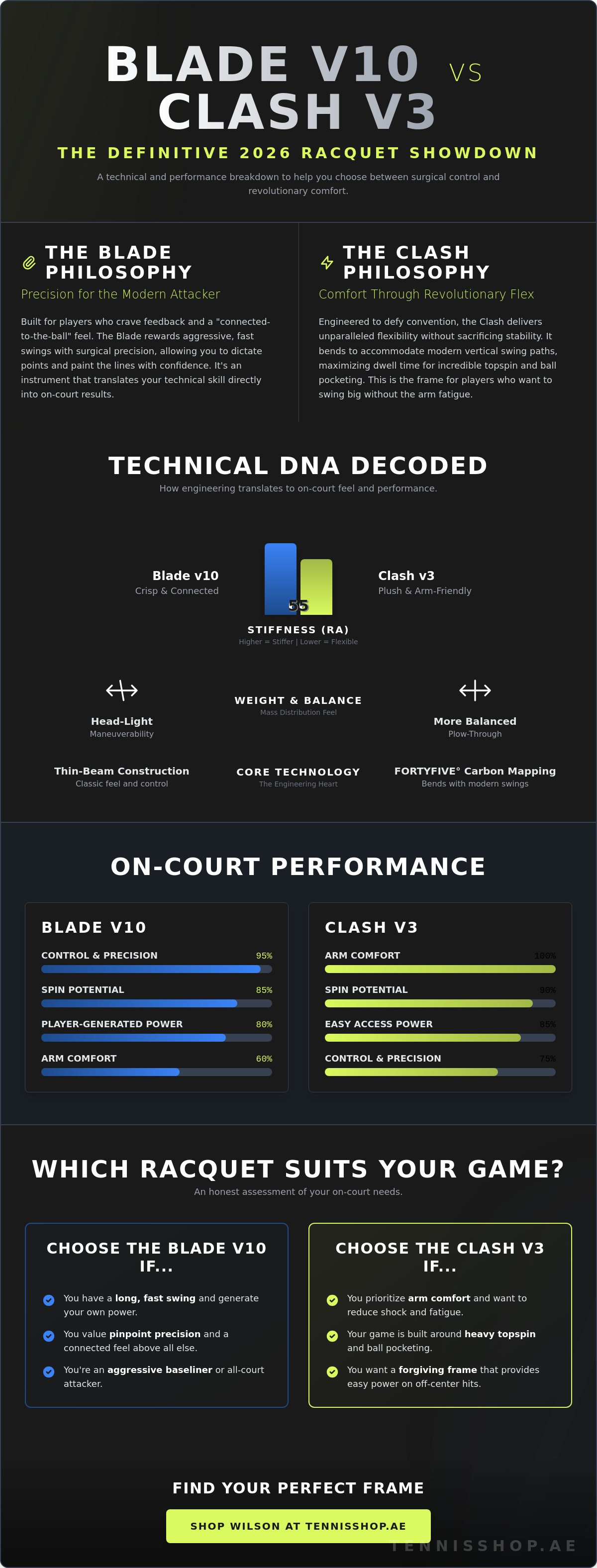
The RA rating is a standardized measure of frame deformation under impact. A higher number indicates a stiffer frame. The Blade v10 typically sits in the mid-to-high 60s, providing the crisp feedback that advanced players demand. This stiffness requires clean timing and physical conditioning to manage the shock. Conversely, the Clash v3 features an exceptionally low RA rating, often in the 50s. This protects the elbow and wrist by absorbing impact energy. It uses FortyFive technology to maintain horizontal stability despite its vertical flexibility, making it the gold standard for arm health.
Weight and Balance: Maneuverability vs. Plow-Through
Comparing the standard Blade 98 v10 to the Clash 100 v3 reveals two different approaches to mass distribution. The Blade 98 is traditionally head-light, emphasizing maneuverability at the net and on quick-fire serves. The Clash 100 often feels more balanced, providing easy power for baseline exchanges without requiring a massive take-back. If you need more mass behind your shots, the "Pro" versions of either line increase the static weight for better plow-through. For those still developing their swing speed, the "Lite" models offer the same tech in a more manageable, faster-swinging package.
Beam width also plays a critical role in the wilson blade vs clash comparison. The Blade’s 20.6mm flat beam is aerodynamic and slices through the air with minimal drag. The Clash features a thicker, more varied beam that aids in stability during off-center hits. Your choice of string pattern further defines the experience:
- 16x19 Pattern: Offers a higher launch angle and easier access to spin. This is the standard configuration for most Clash models.
- 18x20 Pattern: Provides a flatter trajectory and ultimate directional control. It is a favorite for Blade purists who want to hit through the court.
Before you commit to a new frame, ensure you browse the latest Wilson tennis racquets to find the exact weight and balance configuration that fits your current level of play.
On-Court Performance: From Baseline Grinding to Net Dominance
Technical specifications tell one story, but the true test of the wilson blade vs clash rivalry happens during a pressurized third-set tiebreak. On the court, these frames translate their engineering into two distinct playing experiences. One demands your best footwork and timing to unlock its potential, while the other acts as a supportive partner that smooths out the rough edges of your game. Whether you are grinding from the baseline or closing points at the net, the way these racquets interact with the ball will define your tactical options.
Baseline Play: Swing Paths and Spin Potential
The Clash v3 is a spin machine. Because the frame is designed to bend with a vertical swing path, it "pockets" the ball longer than almost any other performance racquet. This creates a massive launch angle and heavy topspin that keeps the ball deep in the court even when you're caught out of position. It is incredibly forgiving on defensive shots. If you find yourself stretched wide, the Clash provides the easy depth needed to reset the point. It's the ultimate tool for the modern player who relies on high-arcing shots to wear down opponents.
In contrast, the Blade v10 rewards a flatter, more traditional trajectory. It is built for the "modern attacker" who looks to take the ball early and drive it through the court. While it doesn't offer the same automatic depth as the Clash, it provides superior directional control. You can change the direction of the ball with surgical precision. However, this comes with a caveat: the Blade is less forgiving on off-center hits. It requires clean, centered contact to maintain its stability. For players who generate their own power and prioritize ball placement over raw spin, the Blade remains the gold standard.
Service and Net Play: Precision vs. Ease of Use
When you step up to the service line, the wilson blade vs clash debate shifts toward the balance between "snap" and "spots." The Clash v3 offers an easy maneuverability that helps you generate high head speed, resulting in a noticeable "snap" on kick serves. It's easy on the shoulder and helps you maintain service speed throughout a long match. The Blade v10, however, is the master of hitting specific targets. Its stable frame and connected feel allow you to aim for the corners of the service box with total confidence.
At the net, the Blade v10 has addressed a common criticism of previous versions. It features improved stability that allows it to hold up against heavy, national-level pace without twisting in your hand. This makes it an elite choice for doubles players who need "touch" for delicate drop volleys. The Clash v3 shines in rapid-fire reflex volleys. Its lightweight feel makes it incredibly fast to position, ensuring you're never late on a ball hit directly at your body. While it may not have the same "scalpel-like" feel as the Blade, its ease of use makes it a favorite for club warriors who want to dominate the forecourt without the steep learning curve.
The Choice: Which Wilson Racquet Suits Your Game Style?
Selecting between the wilson blade vs clash isn't just about technical specs; it's about matching a tool to your specific stage of development. While both frames offer elite technology, they serve different masters. One rewards the disciplined technique of a rising star, while the other provides a safety net for the player who wants to stay on the court for years to come. In 2026, the distinction remains clear: the Blade is a racquet you grow into, while the Clash is a racquet that grows with you.
Who Should Choose the Wilson Blade?
Advanced players and competitive athletes who demand a "player’s racquet" feel should look no further than the Blade v10. It is designed for those who value predictability above all else. If you have a long, fast swing and want the ball to go exactly where you point it, this frame is your best option. It is also the natural progression for rising stars. If you're looking for the right frame for a developing player, check out our guide on Wilson junior tennis racquets to see how the Blade fits into a long-term training plan.
Who Should Choose the Wilson Clash?
The Clash v3 is the gold standard for the "Club Warrior." If you prioritize arm health and want to prevent tennis elbow, this frame’s low RA rating is a lifesaver. It is also ideal for intermediate players who struggle to find consistent depth on their groundstrokes. The frame does the heavy lifting for you. Modern players who utilize a heavy vertical swing path will find the Clash’s flexibility helps them generate massive topspin without the physical toll of a stiffer racquet.
Transitioning between these two frames requires a strategic approach. If you are moving from a Blade to a Clash, expect a much softer feel and a higher launch angle. You may find your shots flying long during your first session, so focus on adding more topspin to keep the ball in play. If you're moving from a Clash to a Blade, be prepared for more physical demand. You will likely need to adjust your stringing setup. A lower tension or a softer multifilament string can help bridge the gap in comfort and help you find the depth you're used to.
The right equipment is an investment in your performance. Whether you need the surgical precision of the Blade or the revolutionary comfort of the Clash, choosing the right frame is the first step toward your best season yet. You can find the full Wilson performance lineup at our shop to ensure you're equipped with the latest 2026 technology.
Optimizing Your Wilson Frame: Strings and Maintenance
Your choice in the wilson blade vs clash debate is only the first step toward peak performance. To unlock the full potential of these 2026 frames, you must pair them with the right string technology. A high-tech carbon frame like the Blade v10 or Clash v3 requires a setup that complements its specific geometry. Without the correct strings and tension, you risk turning a precision instrument into a blunt tool. Professional maintenance ensures that the innovation Wilson engineered into the frame actually translates to your game.
Recommended String Setups
The Blade v10 is a control-oriented frame that excels when paired with polyester strings. These strings provide the necessary snap-back and durability for players with high swing speeds. A full bed of polyester allows you to swing out with confidence, knowing the string bed will provide the spin needed to keep the ball inside the lines. If you find a full bed too stiff, a hybrid setup with a soft cross string can maintain the Blade's precision while adding a touch of comfort.
The Clash v3 benefits from a different approach. Because the frame is already exceptionally flexible, using a multifilament or a high-end hybrid setup can help sharpen its precision. This prevents the "mushy" feel that some players experience when the frame and strings are both too soft. For players competing in the local heat and humidity, we recommend a tension range of 50 to 54 pounds to account for the rapid tension loss caused by high temperatures. This slightly higher tension helps maintain a predictable launch angle even when the climate tries to soften your string bed.
Professional Maintenance and Care
Maintaining the integrity of your frame is just as important as the initial purchase. High-performance racquets like these are sensitive to tension drops and environmental stress. Heat and humidity can cause the carbon fibers to behave differently over time if the racquet is not stored properly. We recommend restringing your racquet as many times per year as you play per week to ensure the playability remains consistent. For a deeper look at the engineering behind these frames, refer to The Ultimate Guide to Wilson Tennis Racquets 2026.
Never underestimate the value of professional racquet stringing to protect your investment. A professional stringer uses constant-pull machines that prevent frame distortion and ensure every knot is tied to exacting standards. This is particularly vital for the wilson blade vs clash comparison, as the Clash's unique flexibility requires a careful hand to avoid uneven stress on the hoop during the stringing process. Regular maintenance keeps your equipment performing at the same level as the pros, allowing you to focus entirely on your strategy and movement.
Elevate Your Performance with the Right Wilson Frame
Choosing between the surgical precision of the Blade v10 and the revolutionary comfort of the Clash v3 is a defining moment for your 2026 season. You now understand that the Blade rewards technical discipline and an aggressive swing path, while the Clash enables massive spin and protects your arm through advanced engineering. Both frames represent the peak of carbon technology, but they cater to different philosophies on the court. It's about finding the tool that matches your specific ambition.
Determining the winner in the wilson blade vs clash debate depends entirely on your specific mechanics and long-term health goals. Whether you're a competitive junior rising through the ranks or a club warrior looking to extend your playing years, the right equipment is your most valuable partner. As an Authorized Wilson Retailer, we offer a premium selection of high-performance gear to help you make this investment with total confidence.
Take the next step in your athletic journey and Shop the Latest Wilson Blade and Clash Collections at TennisShop.ae today. With our expert racquet stringing services available, you can ensure your new frame is optimized for your specific style of play. Your best game is waiting for you. Step onto the court and claim it.
Frequently Asked Questions
Is the Wilson Blade or Clash better for tennis elbow?
The Wilson Clash is the superior choice for players struggling with tennis elbow. Its revolutionary low stiffness rating absorbs impact energy before it reaches your arm. While the Blade v10 offers incredible feel, its stiffer frame requires more physical resilience from the player. Choose the Clash if long-term injury prevention and comfort are your top priorities on the court.
Can a beginner play with a Wilson Blade 98?
Beginners should generally avoid the Wilson Blade 98 because it demands precise timing and a fast, full swing. Its 98 square inch head size and thin beam are designed for advanced control rather than easy power. A beginner will likely find the sweet spot too small, leading to frustration and inconsistent shots. Starting with a more forgiving frame like the Clash 100 provides a much better learning curve.
What is the main difference between the Blade V9 and the Clash V2/V3?
The primary distinction lies in the frame's flexibility and how it responds to your swing path. The Blade V9 utilizes StableFeel technology to provide a connected, traditional response for horizontal hitters. The Clash V2 and V3 models use FortyFive carbon mapping to allow the racquet to bend with a modern vertical swing. This makes the Clash much more forgiving on the arm and easier to generate depth without perfect technique.
Which Wilson racquet generates more spin?
The Wilson Clash generates more spin because its flexible frame allows the ball to sit on the strings longer during the impact. This increased dwell time enables the strings to snap back more effectively, creating a higher launch angle and heavy topspin. While you can hit spin with a Blade, the wilson blade vs clash performance data shows the Clash specifically assists players who use a vertical swing path to dominate from the baseline.
Does the Wilson Clash have enough control for competitive tournaments?
Yes, the Wilson Clash provides ample control for competitive play, particularly in its Pro and Tour iterations. These models feature a thinner beam and more mass, which stabilizes the frame against heavy pace. While it won't offer the surgical precision of a Blade, the Clash allows competitive players to hit big targets with incredible consistency. Many tournament players value this reliability and depth over raw, traditional feel.
What strings should I use in my Wilson Blade to make it more comfortable?
Switch to a high quality multifilament or a soft hybrid setup to increase the comfort of your Wilson Blade. Pairing a stiff performance frame with a harsh polyester string can lead to significant arm fatigue. By using a softer string at a slightly lower tension, you can maintain the Blade's legendary control while reducing the vibration sent to your wrist. It's an effective way to balance elite performance with better arm protection.
Is the Wilson Clash Pro suitable for advanced players?
The Wilson Clash Pro is specifically engineered for advanced players who want a more substantial feel without sacrificing the line's signature flexibility. It features a heavier static weight and a more head-light balance than the standard 100 model. This allows for better plow-through and stability during high speed exchanges. It's the perfect bridge for an elite player who needs a more arm-friendly alternative to traditional, stiff player's frames.
How does the swing weight of the Blade compare to the Clash?
The Wilson Blade typically carries a higher swing weight than the standard Clash models, making it feel more substantial through the air. This higher swing weight rewards players who have full, fast strokes and can manage the extra mass. The wilson blade vs clash comparison shows that while the Clash is more maneuverable for quick reflex volleys, the Blade provides the extra stability needed to drive through the ball on aggressive, point-ending groundstrokes.
From Our Blog

Who Is Elena Rybakina? Rankings, Titles & Career Stats

Naomi Osaka: Grand Slam Titles, Ranking & Career Stats

Aryna Sabalenka: Career, Timeline, Stats & Playiing Style

Mirra Andreeva: Career, Ranking, Stats & Playing Style

Iga Swiatek ranking, stats, titles and records

Laver Cup 2026 Format and Schedule at The O2 London

2026 China Open tennis tournament dates, players, and history

How Coco Gauff rose to the top of women's tennis

Pickleball vs Tennis: What's the Difference Between the Two Sports

Pickleball Rules Guide For Beginners

Pickleball court dimensions and size guide

Who Has Won the Most Grand Slam Titles in Tennis?
Tennis Strings Guide: Everything You Need to Know
Tennis Scoring: System, Points, Games, Sets & Tie-Break
How to Improve Tennis Backhand Like a Pro: Tips & Technique

Cincinnati Open Tennis: Schedule, History & Guide

Alexander Zverev Career, Titles, Stats & Records

Who Is Novak Djokovic? Career Timeline, Titles, Stats & Records

Jannik Sinner 2026: Rankings, Stats & Latest News

US Open 2026: Schedule, Players, Venue, Scoring & Rules

Wimbledon 2026 Guide: Schedule, Players, & Rules

Serena Williams Wimbledon 2026 Comeback: Latest Update

Roland Garros 2026: French Open Overview & Predictions

Italian Open 2026: Overview, Predictions and Legacy

How to Become a Professional Tennis Player

Tennis Miami Open 2026: Overview, Winners, History & Facts

7 Steps to Master a Tennis Serve (Beginner’s Guide)

7 Tips to Choose the Best Padel Shoes | Complete Guide

Pickle Ball vs Padel: What’s the Difference in Rules and Play?

Dubai Duty Free Tennis Championships 2026: Complete Guide

Tennis Elbow Exercises & Prevention: Complete Player Guide

Guide to Mubadala Abu Dhabi Open 2026: Tickets & Info

Top Tennis Warm Up Exercises to Boost Performance

Six Kings Slam 2025: Sinner’s Win & Riyadh’s Tennis Rise

Australian Open 2026: Everything You Need to Know