The secret to that heavy, baseline-dominating dip isn't just about how hard you swing. It's about how much your strings can move and snap back into place. You have likely felt the frustration of a fresh setup losing its bite after just a few hours, leaving your shots flying long. It's a common struggle for competitive players searching for the best tennis strings for spin. You want that aggressive RPM without the stiff, arm-shredding feedback that often comes with traditional polyesters.
This guide reveals the elite strings engineered to maximize snapback and precision in 2026. You'll discover why the Weiss Cannon Ultra Cable 17 remains a top contender and how new innovators like HighString Zeus 2.0 are redefining the spin game. We'll break down the relationship between string shape and RPM while helping you find a signature setup that maintains its performance for more than a single session. From the latest co-polyester technology to professional racquet stringing tips, it's time to transform your game and dominate the court.
Key Takeaways
- Master the mechanics of "snapback" to understand how string movement and friction coefficients generate massive RPMs on every stroke.
- Explore the elite 2026 lineup featuring the best tennis strings for spin, including the iconic Solinco Hyper-G and Babolat RPM Blast.
- Learn why thinner gauges and lower tensions are the secret to maximizing ball bite while protecting your arm from fatigue.
- Discover how professional racquet stringing on high-end machines ensures the consistency needed to maintain your signature performance profile.
The Science of Spin: Why Your Strings Matter More Than Your Racquet
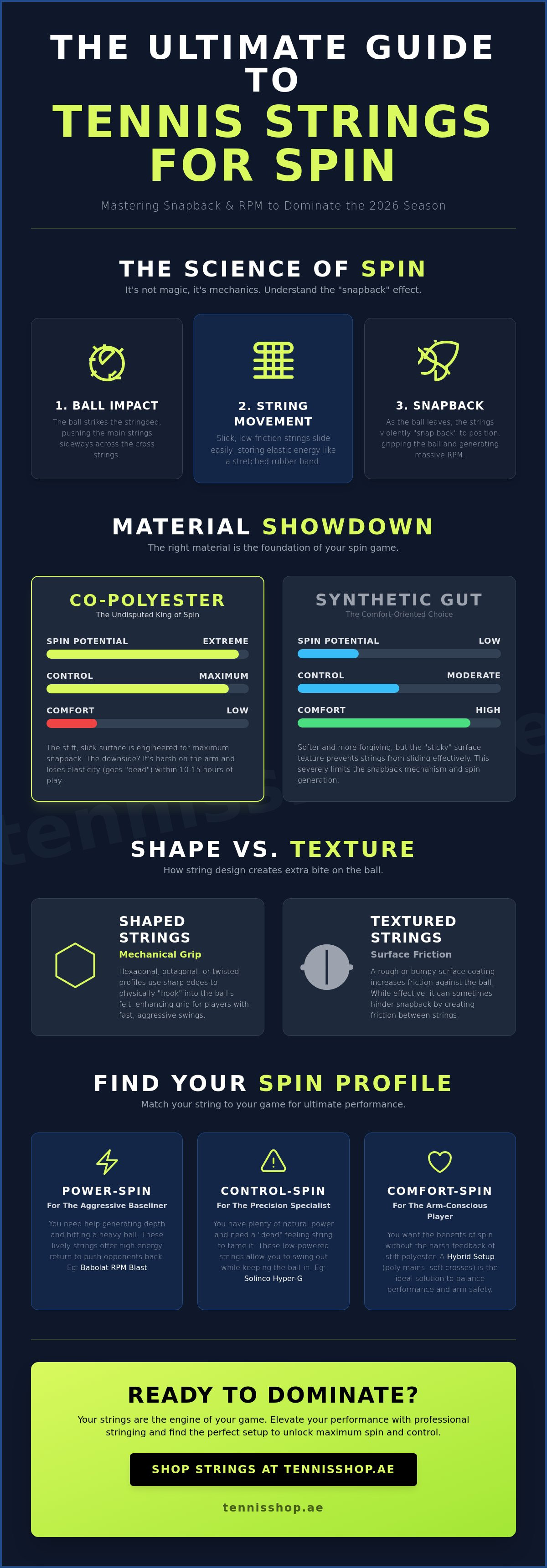
Your racquet provides the platform for your game, but the strings are the engine that drives every shot. To master the modern baseline game, you have to understand that spin isn't just about your swing path. It's a mechanical process. High-performance strings generate RPMs through a phenomenon called snapback. When you strike the ball, the main strings slide across the crosses and then violently recoil to their original position. This rapid movement kicks the ball as it leaves the string bed, creating the heavy topspin that makes your shots dip sharply inside the lines.
For this process to work effectively, the strings need a low coefficient of friction. They must be slippery enough to slide against each other without getting stuck. This is why co-polyester is the undisputed king of the court. Unlike natural gut or nylon, polyester has the specific stiffness and surface slickness required for this elastic deformation. This performance comes with a shelf life. These materials lose their elasticity quickly. Even if they don't break, they go dead, which means they lose the ability to snap back. Players seeking the best tennis strings for spin should plan on restringing every 10 to 15 hours of play to maintain that elite level of bite.
Polyester vs. Synthetic Gut: The Spin Gap
Many recreational players stick with synthetic gut for comfort, but they're sacrificing massive spin potential. Soft strings like multifilament are too sticky. They grab the ball but fail to slide and snap back, resulting in a much flatter trajectory. Modern baseline play demands the stiffness of a co-poly to control high-speed swings and provide the necessary recoil. If you have a history of tennis elbow or a very compact swing, you might want to avoid a full bed of stiff polyester. In these cases, a hybrid setup is often the smartest move to balance performance and arm safety. You can learn more about how different materials affect playability by exploring The Science of Spin: Why Your Strings Matter for a technical breakdown of string composition.
Shaped vs. Textured Strings: Which Bites Better?
When searching for the best tennis strings for spin, you'll encounter two main designs: shaped and textured. Shaped strings use geometric profiles, such as hexagonal or pentagonal edges, to physically hook into the ball's felt. This mechanical grip is incredibly effective for players with fast swing speeds who want maximum control. Textured or rough strings use a bumpy surface to increase friction against the ball. While these can feel like they have more grip, they sometimes increase friction between the strings themselves, which can actually hinder the sliding motion. Snapback is the rapid sliding and recoiling of the main strings that serves as the primary driver of spin in modern tennis.
Categorising Spin: Power, Control, and Comfort Profiles
Spin is rarely a standalone benefit. To truly dominate from the baseline, you have to pair your RPM potential with a specific playstyle profile. The best tennis strings for spin aren't universally perfect for everyone; they're specialized tools designed to solve specific court problems. Whether you're struggling to keep the ball deep or finding that your shots are flying long, choosing a string that matches your performance needs is the only way to find your signature setup.
Most players fall into one of three categories: Power-Spin, Control-Spin, or Comfort-Spin. Identifying your profile helps you filter through the noise of technical specs and focus on what actually improves your win rate. Understanding the physics behind these choices is essential for any serious athlete. You can dive deeper into the mechanics of how materials influence your shots by reading The 2026 Elite Roundup: Top Tennis Strings for Maximum Spin, which details the interaction between polyester and ball rotation.
Spin and Power: For the Aggressive Baseliner
If you play an attacking game but struggle to generate natural depth, a power-spin string is your best ally. These strings, like the Babolat RPM Blast, feature a more "lively" response. They offer high energy return, meaning the ball leaves the string bed with significant velocity and weight. This helps you push your opponent back even when you aren't perfectly balanced. To maximize this effect, pair these strings with powerful frames like the Wilson Ultra or the Babolat Pure Drive. This combination creates a heavy ball that is difficult for opponents to time.
Spin and Control: For the Precision Specialist
Big hitters often have the opposite problem. They have plenty of natural power but need a "dead" string that won't launch the ball. Control-spin strings like Solinco Confidential or Luxilon 4G provide a predictable, low-powered response. This allows you to swing at maximum speed without fear of the ball sailing past the baseline. These strings are among the best tennis strings for spin because they allow the player to provide the energy while the string provides the grip. These setups work beautifully with Wilson tennis racquets, particularly the Blade series, which emphasizes feel and accuracy.
The Comfort-Spin Niche
Not every player can handle the stiffness of a traditional tour-level polyester. If you have sensitive elbows or a history of tendonitis, you should look for "soft" polyesters. These strings are chemically modified to be more flexible, offering a more forgiving feel on impact while still providing the hexagonal or pentagonal shapes needed for bite. If you're unsure which profile fits your game, our experts at TennisShop.ae can help you select a setup that protects your arm without sacrificing your spin potential.
The 2026 Elite Roundup: Top Tennis Strings for Maximum Spin
Selecting the right equipment is a personal journey, but certain models consistently rise to the top of the performance charts. These selections represent the absolute best tennis strings for spin available in 2026, each offering a unique mechanical advantage to help you control the baseline. Whether you prioritize sharp edges for maximum grip or a slippery coating for explosive snapback, these strings are engineered for high-performance athletes.
- Solinco Hyper-G: This iconic green string remains the gold standard for many. Its square profile provides consistent bite, while its unique chemical composition ensures tension doesn't drop off a cliff after the first set.
- Babolat RPM Blast: A staple for players using Babolat Tennis Racquets, this octagonal string features a silicone coating. This design reduces friction between strings, allowing for the violent snapback required for heavy, dipping shots.
- Luxilon ALU Power Rough: This legendary textured string is a favorite on the pro tour. The indented surface increases the contact area with the ball, providing enhanced feel and rotation without sacrificing the classic ALU Power control.
- Yonex Poly Tour Spin: The pentagonal shape of this string creates a very predictable launch angle. It's a powerhouse for players who want to swing big and know exactly where the ball will land.
- Solinco Tour Bite: Featuring some of the sharpest edges in the game, Tour Bite is designed for ultimate grip. It's a stiff, high-performance option for those who want to feel the string "hook" into the ball's felt.
The 'New School' Contenders for 2026
Innovation in 2026 has focused heavily on longevity. Newer co-polys are now utilizing advanced low-friction coatings that resist "notching" far better than heritage models. This means your spin potential stays peak for longer periods. We're also seeing a massive surge in "Soft" versions of classics, such as Hyper-G Soft. These provide the same geometric advantages for spin but with a modified molecular structure that absorbs more shock. This shift allows competitive players to maintain a full bed of polyester without the traditional risk of wrist or elbow fatigue.
Hybrid Setups: The Best of Both Worlds
Many elite players are moving away from full polyester beds in favor of hybrid setups. By using a polyester in the mains and a natural gut or high-end multifilament in the crosses, you get a lethal combination of spin and feel. The polyester mains provide the snapback and bite, while the softer crosses improve the overall comfort and "pocketing" of the ball. Research in The Science of Spin Generation suggests that the friction between these two different materials can actually enhance the sliding motion of the mains. If you want to maximize rotation, always place your spin-friendly co-poly in the main strings. Pairing these setups with professional racquet stringing ensures that your tensions are calibrated perfectly for your specific frame, whether you're rocking the latest Wilson or Babolat models.
Optimising for Performance: Gauge, Tension, and Climate Factors
Even the best tennis strings for spin won't perform at their peak if you neglect the technical setup. Many players mistakenly believe that cranking up the tension will "trap" the ball and create more rotation. The reality is the opposite. High tension actually restricts string movement, which stifles the snapback effect required for heavy spin. By lowering your tension, you provide the string bed with the freedom to slide and recoil. This extra millisecond of dwell time allows the string to grab the ball's felt and launch it with significantly higher RPMs.
Performance optimization also requires a deep understanding of elasticity. When a string loses its ability to snap back, it is considered "dead." Playing with dead strings is a danger to your game and your health. As the material becomes brittle, it stops absorbing shock, sending those vibrations directly into your wrist and elbow. To maintain your spin potential and protect your arm, you should restring your racquet every 15 to 20 hours of play. This ensures the co-polyester maintains the resilient snapback that defines the modern game.
Choosing Your Gauge: 16 vs. 17 vs. 18
String gauge refers to the thickness of the material, and it has a direct impact on how deep the strings "bite" into the ball. Choosing the right thickness is a balance between performance and budget. Consider these three standards for your next setup:
- 16 Gauge (1.30mm): This is the durability standard. It's ideal for heavy hitters who break strings frequently but still want the benefits of a shaped profile.
- 17 Gauge (1.25mm): The most popular choice for competitive players. It offers a noticeable "spin-boost" over thicker options while maintaining reasonable longevity.
- 18 Gauge (1.20mm): The ultimate spin option. Thinner strings penetrate deeper into the ball's felt for maximum grip, though they will break much faster under heavy use.
Tension Tactics for High-Heat Environments
Players in the UAE face a unique challenge that many generic guides ignore. High humidity and relentless heat accelerate tension loss significantly. When your racquet sits in a hot car or a humid locker room, the molecules in the polyester relax, causing the tension to "mush" out. This kills the crisp response needed for precision spin. To combat this, consider stringing your racquet 2 to 3 lbs tighter than your preferred tension to account for that initial heat-induced drop.
Environmental protection is your first line of defense. Always store your equipment in thermally lined Tennis Bags from brands like Wilson or Babolat to mitigate these temperature swings. If you've noticed your shots flying long or your arm feeling fatigued after a session in the heat, it's likely time for a refresh. Book your Professional Racquet Stringing at TennisShop.ae to ensure your gear is calibrated for the local climate and ready for elite performance.
Professional Stringing: Elevate Your Game with TennisShop.ae
You have identified the best tennis strings for spin, but the final step to baseline dominance lies in the precision of the installation. A high-performance co-polyester requires an expert touch and elite equipment to reach its full potential. At TennisShop.ae, we utilize constant pull electronic stringing machines. Unlike manual crank stringers that can lose tension during the knotting process, constant pull technology ensures every single string is pulled to the exact poundage requested. This level of accuracy is essential for maintaining the uniform string bed required for predictable snapback and explosive RPMs.
Consistency is the foundation of a signature setup. If your tension varies by even two pounds between sessions, your timing will suffer. We provide a reliable, professional service that allows you to experiment with confidence. Our specialists understand how to balance the stiffness of a spin-friendly string with the specific flex of your frame. We serve players across the UAE with professional racquet stringing and nationwide delivery, ensuring your gear is match-ready no matter where you play.
Customise Your Setup with Expert Advice
Every player has a unique swing path. Our team evaluates your stroke mechanics to determine if you need a shaped string for extra bite or a slicker surface for maximum recoil. We often recommend trying a tension ladder, which involves stringing the same model at different tensions over several weeks, to find your personal sweet spot. This data-driven approach takes the guesswork out of your equipment. Book your professional racquet stringing service today and let our experts fine-tune your performance engine.
Complete Your Spin Arsenal
Generating heavy spin requires violent, explosive movement. To support this level of physical intensity, your footwear must be up to the task. High-performance tennis shoes from brands like Asics, Nike, and On provide the lateral stability needed to load your weight and explode through the ball. Don't overlook the smaller details either. A fresh overgrip is vital for maintaining a firm handle during high-swing-speed shots. If your hand slips even a fraction, your spin potential evaporates. Explore our full range of professional tennis gear online to complete your setup and dominate the court with confidence.
Dominate the Court with Precision Spin
Finding your signature setup is about more than just picking a brand. It's about aligning the science of snapback with your specific swing path and the local environment. You now understand how gauge, tension, and material shape work together to create the heavy, dipping shots that define modern tennis. Whether you're a precision specialist or an aggressive baseliner, selecting the best tennis strings for spin is the most effective way to upgrade your performance without changing your racquet.
As an authorized retailer for Wilson, Babolat, and Luxilon, we provide the elite equipment you need to stay ahead of the competition. Our expert stringing service is trusted by competitive athletes across the Emirates to deliver consistent, tour-level results every time you step on court. With nationwide shipping across the Emirates, your next performance upgrade is always within reach. Shop the Best Spin Strings and Book Your Restringing Service at TennisShop.ae
Take the technical knowledge you've gained and turn it into a competitive advantage. Your best game is just one string job away. See you on the baseline!
Frequently Asked Questions
What is the best tennis string for spin and power?
Babolat RPM Blast stands out as the premier choice for players seeking this lethal combination. Its octagonal profile provides the necessary bite, while a specialized silicone coating ensures the explosive snapback needed for heavy shots. This string is a staple for aggressive baseliners who want to push opponents back with both high velocity and massive RPMs.
Do textured strings actually produce more spin than smooth ones?
Textured strings physically hook into the ball's felt for better grip, which is particularly effective at moderate swing speeds. However, smooth polyesters often generate more spin at high swing speeds because they slide and recoil more efficiently. The choice depends on your mechanics; you need a balance between mechanical bite and the string's ability to snap back into place.
How often should I restring my racquet to keep the spin potential?
Restring your racquet every 15 to 20 hours of play to preserve your performance. Co-polyester materials lose their elasticity relatively quickly. Once the strings stop snapping back, your control vanishes and the dead feel can lead to arm fatigue. Regular maintenance is non-negotiable if you want to maintain a competitive edge on the court.
Does higher string tension increase the spin rate?
Lower tension actually increases your spin rate by allowing for more string movement. When strings are pulled too tight, they cannot slide or recoil effectively against each other. Dropping your tension by a few pounds creates more dwell time and a more pronounced snapback effect, which is essential when using the best tennis strings for spin.
Which string gauge is best for maximum spin?
Thinner strings like 17 (1.25mm) or 18 (1.20mm) are superior for generating rotation. These gauges penetrate deeper into the ball's surface to maximize friction during impact. While they offer a significant performance boost, heavy hitters should be aware that these thinner options will break much faster than a standard, thicker 16-gauge string.
What are the most durable tennis strings for spin?
Solinco Hyper-G and Luxilon 4G are industry leaders for durability and tension stability. These strings are designed to resist notching, which occurs when the main strings cut grooves into the crosses. By maintaining a smooth sliding surface for a longer period, they preserve the sliding motion required for consistent spin over several intense matches.
Can I get professional racquet stringing in the UAE through TennisShop.ae?
TennisShop.ae provides professional racquet stringing services with nationwide delivery across the UAE. Our experts use high-end electronic constant-pull machines to guarantee precise tension calibration every time. Whether you are in Dubai, Abu Dhabi, or the Northern Emirates, you can access tour-level maintenance to keep your equipment performing at its absolute peak.
Are polyester strings bad for tennis elbow?
Stiff polyesters can be harsh on the arm, but modern soft co-polys and hybrid setups offer a much more forgiving feel. If you have a history of sensitivity, avoid high tensions and don't play with dead strings that have lost their elasticity. Pairing a spin-friendly polyester main with a softer cross string is an excellent way to get the best tennis strings for spin without sacrificing your arm health.
From Our Blog

Who Is Elena Rybakina? Rankings, Titles & Career Stats

Naomi Osaka: Grand Slam Titles, Ranking & Career Stats

Aryna Sabalenka: Career, Timeline, Stats & Playiing Style

Mirra Andreeva: Career, Ranking, Stats & Playing Style

Iga Swiatek ranking, stats, titles and records

Laver Cup 2026 Format and Schedule at The O2 London

2026 China Open tennis tournament dates, players, and history

How Coco Gauff rose to the top of women's tennis

Pickleball vs Tennis: What's the Difference Between the Two Sports
Pickleball Rules Guide For Beginners

Pickleball court dimensions and size guide

Who Has Won the Most Grand Slam Titles in Tennis?
Tennis Strings Guide: Everything You Need to Know

Tennis Scoring: System, Points, Games, Sets & Tie-Break
How to Improve Tennis Backhand Like a Pro: Tips & Technique

Cincinnati Open Tennis: Schedule, History & Guide

Alexander Zverev Career, Titles, Stats & Records

Who Is Novak Djokovic? Career Timeline, Titles, Stats & Records

Jannik Sinner 2026: Rankings, Stats & Latest News

Carlos Alcaraz 2026: Ranking, Records & Grand Slam Outlook

US Open 2026: Schedule, Players, Venue, Scoring & Rules

Serena Williams Wimbledon 2026 Comeback: Latest Update

Roland Garros 2026: French Open Overview & Predictions

Italian Open 2026: Overview, Predictions and Legacy

How to Become a Professional Tennis Player

Tennis Miami Open 2026: Overview, Winners, History & Facts

7 Steps to Master a Tennis Serve (Beginner’s Guide)

7 Tips to Choose the Best Padel Shoes | Complete Guide

Pickle Ball vs Padel: What’s the Difference in Rules and Play?

Dubai Duty Free Tennis Championships 2026: Complete Guide

Tennis Elbow Exercises & Prevention: Complete Player Guide

Guide to Mubadala Abu Dhabi Open 2026: Tickets & Info

Top Tennis Warm Up Exercises to Boost Performance

Six Kings Slam 2025: Sinner’s Win & Riyadh’s Tennis Rise

Australian Open 2026: Everything You Need to Know

Top Longest Tennis Matches Ever Played in History