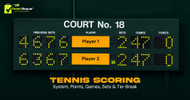

Tennis Scoring System: A Complete Guide
If you've ever watched a tennis match and wondered why the score jumps from 30 to 40 instead of 30 to 45, you're not alone. The tennis scoring system trips up plenty of new fans, and even some players who've been on the court for years can't fully explain where it came from. This guide walks you through every layer of tennis scoring, from the very first point to match point, with no jargon left unexplained.
Whether you're watching the Australian Open for the first time or picking up a racket yourself, understanding tennis scoring points changes the entire experience. Once it clicks, you'll start reading a scoreboard the way a commentator does.
What is tennis scoring?
Tennis scoring works across three levels: points, games, and sets. Each level builds on the one below it. Win enough points, and you win a game. Win enough games, and you win a set. Win enough sets, and you win the match. The tennis counting system is one of the few in sport where there's no clock involved at all. Play goes on until someone wins, which is part of what makes a five-set Wimbledon final feel like an endurance test.
How tennis scoring works
Every rally has a point at the end. Points make games. Games grow into sets. You have to win at least four points to win a game, at least six games to win a set, and two or three sets to win the match – depending on the format of the tournament. That is the basic structure of the tennis scoring system and everything else is detail layered on top of that.
Why tennis uses a unique scoring system
The tennis point system is old. Historians trace its roots to 15th-century France, where a game called jeu de paume was played, and clock faces may have been used to keep score. Points moved from 15 to 30 to 45, and then to 60 for the win. Over time, 45 was shortened to 40, likely because it was faster to call out. No other mainstream sport counts this way, which is why the tennis counting system still throws beginners off centuries later.
Difference between points, games, and sets
Think of it in layers. A point is the smallest unit. A game is made up of points. A set is made up of games. A match is made up of sets. You can win a game while losing the set. You can win a set while losing the match. That hierarchy is what makes tennis scoring feel so different from football or basketball, where one number on a scoreboard tells the whole story.
Tennis points explained: step by step
Meaning of love, 15, 30, and 40
"Love" means zero. Nobody knows exactly why, though one popular theory links it to the French word l'oeuf, meaning egg, which looks like a zero. From love, points go 15, 30, 40, and then game. The server's score is always called first. So "30-15" means the server has 30 and the receiver has 15.
How players win a game in tennis
You win a game by reaching 40 and winning the next point, provided your opponent is not also at 40. Four points, minimum. If the score gets to 40-40, things get more complicated.
What happens after 40-40 in tennis
40-40 is called "deuce." From deuce, you cannot win the game with just one more point. You need to win two consecutive points. The first gives you "advantage." If you lose the next rally, the score goes back to deuce, and you start again. This can repeat indefinitely, which is why close games sometimes go on for what feels like forever.
Advantage in tennis scoring
After deuce, whoever wins the next point holds "advantage." Call it "ad-in" if the server holds it, "ad-out" if the receiver does. Win the following rally from advantage, and the game is yours. Lose it, and it's deuce again. Advantage is the moment a game hangs on a single rally, which is why it's one of the most tense points in any match.
How games, sets, and matches are won
Points win games. Games win sets. Sets win matches. Each step has its own rules.
Rules for winning a set in tennis
You need six games to win a set, and you must lead by at least two. So 6-4 wins a set. 6-5 does not. At 6-6, most sets go to a tie-break, though some final sets play differently.
Understanding tie-break rules
When the set score is 6-6 , a tie-break is played . It is played to seven points and you must win by two. The tie-break is won by the first to reach seven points, with a two-point advantage, winning the set 7-6. Tie-break points are scored in the normal way (1, 2, 3, etc.) not 15, 30, 40. Service alternates every two points and the next server in the match rotation serves one point.
Best-of-three vs best-of-five set matches
WTA and ATP Tour matches are typically best-of-three sets, meaning the first player to win two sets wins the match. Grand Slams play differently. Men's singles at all four Grand Slams, plus the Davis Cup, use best-of-five. First to three sets wins. Women's singles stays at best-of-three across all tournaments. Best-of-five matches can run four to five hours, which is why the scoring format makes such a difference to how a tournament unfolds.
Final set rules in professional tennis
Final set rules vary across tournaments. Wimbledon now plays a tie-break at 12-12 in the final set, after historic matches like Isner vs. Mahut in 2010 ran to 70-68 in the fifth. The US Open plays a standard tie-break at 6-6, even in the final set. Roland Garros and the Australian Open play a match tie-break (first to 10 points) at 6-6 in the deciding set. No single rule applies everywhere, so it's worth checking each tournament's format going in.
Tennis scoring examples for beginners
Let's put the tennis scoring system into practice with a few quick scenarios.
Standard tennis game
Player A serves. The rally goes like this: Player A wins the first point (15-love), Player B wins the second (15-15), Player A wins the third (30-15), Player A wins the fourth (40-15), Player A wins the fifth. Game over. Player A wins the game 40-15 with room to spare.
Deuce and advantage situation
Same game, different ending. Score reaches 40-40 (deuce). Player A wins the next rally (advantage A). Player B wins the rally after that (back to deuce). Player A wins again (advantage A). Player A wins the next point. Game goes to Player A. This kind of back-and-forth is common on break points, where the receiver has a chance to win the server's game.
Tie-break in tennis
The set is level at 6-6. A tie-break starts. Player A serves the first point. After that, serve switches every two points. The score goes A 4, B 5, A 5, B 6, A 6, A 7. Player A wins 7-6 at the tie-break, and takes the set 7-6. The tie-break score appears in parentheses on official scoreboards: 7-6(6), where the 6 shows the loser's tie-break score.
Full match scoreline
A completed match scoreline might look like: 6-4, 3-6, 7-6(4). This means the first player won the first set 6-4, lost the second 3-6, and won the third set in a tie-break, with the opponent scoring 4 points in the tiebreak. Three sets, two won, match over.
Tennis scoring terms
A few terms come up every broadcast that are worth knowing before you sit down to watch.
Meaning of ace, break point, and set point
An ace is a serve the receiver can't touch. It wins the point outright for the server. A break point is when the receiver has a chance to win the server's game, sitting at advantage on the returner's side, or at 40-30/40-15 in the receiver's favor. A set point is when one player is one point away from winning the set.
What is a break of serve?
If you win a game on your opponent’s serve, it’s called a “break.” It's one of the most important points in tennis scoring because the server is naturally favored. Breaking serve shifts momentum and in many matches decides the entire outcome of a set. Players who win more break points than they lose tend to win more matches.
Difference between match point and championship point
A match point is when a player is one point from winning the match. A championship point is when a player is one point from winning a tournament. The distinction matters during finals. The term "championship point" only applies in a tournament's final round, and it carries a different emotional weight entirely.
Conclusion
Tennis scoring is layered but logical. Points run from love to 15, 30, and 40. Deuce forces players to win by two. Games build into sets, which require six games and a two-game margin. Tie-breaks settle sets at 6-6. Matches go best-of-three or best-of-five depending on the tournament. Once you know the structure, reading a live scoreboard becomes second nature. The tennis points explained here apply across every level of the game, from a club match to a Grand Slam final.
FAQs
How does a tie-break work in tennis?
A tie-break is played when a set reaches 6-6. The first player to reach seven points, with a lead of at least two, wins the tie-break and the set. Points are counted numerically (1, 2, 3...), not in the standard 15/30/40 format.
Why is tennis scored 15/30/40?
The scoring likely came from a clock-face system used in early French ball games, where points moved in 15-minute increments around the dial. The jump from 45 to 40 happened over time as a practical shorthand, though the exact origin is still debated among historians.
How are tennis matches scored in Grand Slams?
Women's singles at Grand Slams uses best-of-three sets. Men's singles uses best-of-five. Final set rules vary by tournament: Wimbledon and Roland Garros use a tie-break at 12-12 and 6-6 respectively, while the US Open plays a standard tie-break at 6-6 in all sets.
What does love mean in tennis?
In tennis, love means nothing. The precise origin is debated . One popular theory relates it to the French word l'oeuf ( egg ) , referring to the oval shape of zero . If the score is 0-0 at the beginning of a game, it is love-all.
From Our Blog

Shanghai Masters 2026: Seeds, Start Date & Where to Watch

Paris Masters Tennis Guide: Schedule, Points & Payouts

Who Is Elena Rybakina? Rankings, Titles & Career Stats

Naomi Osaka: Grand Slam Titles, Ranking & Career Stats

Aryna Sabalenka: Career, Timeline, Stats & Playiing Style

Mirra Andreeva: Career, Ranking, Stats & Playing Style

Iga Swiatek ranking, stats, titles and records

Laver Cup 2026 Format and Schedule at The O2 London

2026 China Open tennis tournament dates, players, and history

How Coco Gauff rose to the top of women's tennis

Pickleball vs Tennis: What's the Difference Between the Two Sports
Pickleball Rules Guide For Beginners
Pickleball court dimensions and size guide

Who Has Won the Most Grand Slam Titles in Tennis?

Tennis Strings Guide: Everything You Need to Know
Tennis Scoring: System, Points, Games, Sets & Tie-Break

How to Improve Tennis Backhand Like a Pro: Tips & Technique

Cincinnati Open Tennis: Schedule, History & Guide

Alexander Zverev Career, Titles, Stats & Records

Who Is Novak Djokovic? Career Timeline, Titles, Stats & Records

Jannik Sinner 2026: Rankings, Stats & Latest News

US Open 2026: Schedule, Players, Venue, Scoring & Rules

Wimbledon 2026 Guide: Schedule, Players, & Rules

Serena Williams Wimbledon 2026 Comeback: Latest Update

Roland Garros 2026: French Open Overview & Predictions

Italian Open 2026: Overview, Predictions and Legacy

How to Become a Professional Tennis Player

Tennis Miami Open 2026: Overview, Winners, History & Facts

7 Steps to Master a Tennis Serve (Beginner’s Guide)

7 Tips to Choose the Best Padel Shoes | Complete Guide

Pickle Ball vs Padel: What’s the Difference in Rules and Play?

Dubai Duty Free Tennis Championships 2026: Complete Guide

Tennis Elbow Exercises & Prevention: Complete Player Guide

Guide to Mubadala Abu Dhabi Open 2026: Tickets & Info

Top Tennis Warm Up Exercises to Boost Performance

Six Kings Slam 2025: Sinner’s Win & Riyadh’s Tennis Rise

Australian Open 2026: Everything You Need to Know